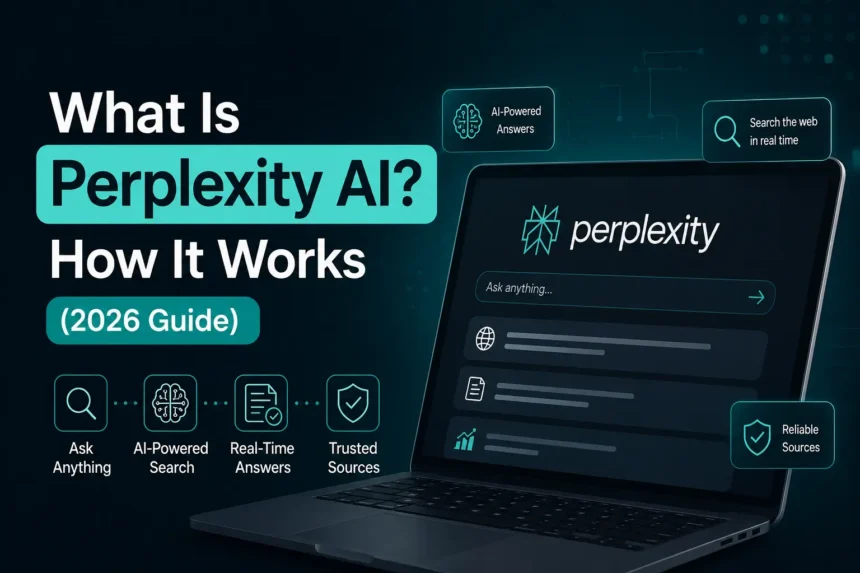
If you’ve ever typed a question into Google only to have to browse through five different pages to get one meaningful response, you already understand the problem that Perplexity AI was intended to tackle. This guide will explain what Perplexity AI is, how it works step by step, who owns it, how much it costs, and how it compares to ChatGPT and Google Gemini.
- What Is Perplexity AI?
- How Does Perplexity AI Work?
- Step 1 – Understanding the Query
- Step 2 – Live Web Search & Retrieval
- Step 3 – Answer Synthesis via LLM
- Step 4 – Citations & Source Verification
- Who Owns Perplexity AI?
- Key Features of Perplexity AI
- Perplexity AI Pricing / Plans
- Perplexity.ai vs ChatGPT vs Google Gemini (Best AI for Perplexity-Style Search)
- Limitations and Things to Watch For
- Frequently Asked Questions
- Is Perplexity AI free?
- Is Perplexity AI safe and accurate?
- What is Perplexity AI used for?
- Perplexity AI vs Google — which is better?
- Who owns Perplexity AI?
- Bottom Line
What Is Perplexity AI?
Perplexity AI is an AI-powered “answer engine” that scours the live web to provide a single, unambiguous written answer, rather than a list of links. Each answer has numbered citations so you can see where the information came from. Perplexity AI is different from a conventional chatbot since it doesn’t just assume from memory it seeks things up in real time. This makes AI perplexity excellent for current events, research, and fact checking.
How Does Perplexity AI Work?
Perplexity AI is a blend of a search engine and a smart research helper. You type a question. Behind the scenes 4 things happen one after the other.
Step 1 – Understanding the Query
The system first processes your inquiry using natural language processing (NLP). That means it works out what you really want to know, not simply the words you used. When you type in “best budget laptops for students,” it recognizes you want a comparison and a recommendation, not simply the term “laptop.”
Step 2 – Live Web Search & Retrieval
Then, Perplexity throws your inquiry out to the live internet. It acts like a search engine, pulling in pages from news sites, official websites, research papers and other credible sources. That’s what makes it different from prior AI chatbots that could only use information from their training data.
Step 3 – Answer Synthesis via LLM
After it has acquired some sources, a large language model (LLM) reads them and writes a brief, simple answer in plain terms. This is not a copy-paste from a single page but a combination of facts from several pages into one easy to understand response.
Step 4 – Citations & Source Verification
Finally, the answer is given with few numbered citations for each fact, like footnotes. You can click on any of them to go to the original source and verify the information yourself. This phase of citation is one of the primary reasons people believe in perplexity.ai is a lot more than just a standard chatbot answer.
The simple flow looks like this:
Your Question → Web Search → Gathering Sources → AI Writes the Answer → Citations Added → You Get a Sourced Answer
Who Owns Perplexity AI?
Perplexity AI is a private American firm, not a publicly traded company that anybody may buy shares of on the stock market. It was formed in August 2022 by four people: Aravind Srinivas, Denis Yarats, Johnny Ho, and Andy Konwinski. Perplexity AI, Inc. was founded in August 2022 by Aravind Srinivas, Denis Yarats, Johnny Ho, and Andy Konwinski. Aravind Srinivas is the CEO and co-founder of Perplexity AI. Before that, he worked at research laboratories including Google DeepMind and OpenAI. He was a researcher at Google DeepMind, Open AI and other AI research institutes.
The company has expanded rapidly. Over multiple rounds of funding, it has raised money from well-known investors including Nvidia, Jeff Bezos and SoftBank Vision Fund 2. Other investors on the company’s cap table are NEA, IVP, NVIDIA, Databricks, Bessemer Venture Partners, SoftBank Vision Fund 2, Accel and Jeff Bezos. After another round of fundraising by early 2026, it was valued at roughly $21-22 billion. In early 2026, Perplexity AI’s Series E-6 investment round valued the company at $21.21 billion. So to summarize, Perplexity AI is owned by its founders, staff and a huge group of private investors no single individual or big tech corporation owns it altogether.
Key Features of Perplexity AI
No longer is Perplexity only a search box. Its primary tools are the following, simply:
| Feature | What It Does |
| Quick Search | Fast, basic answers with citations free for everyone |
| Pro Search | Deeper search using stronger AI models, for more detailed answers |
| Deep Research | Reads many sources and builds a full research report on a topic |
| Labs / Create | Builds simple reports, spreadsheets, and mini web apps from a prompt |
| Model Selector | Lets you pick which AI model answers your question (such as GPT or Claude) |
| Comet Browser | A free AI-powered web browser with a built-in assistant sidebar |
| Perplexity Assistant | A voice/text assistant that can complete small tasks for you |
| Shopping & Finance Tools | Product comparisons and real-time stock or market data |
Perplexity AI Pricing / Plans
Perplexity is a paid subscription. In February 2026, the organization totally stopped advertising and switched to a subscription-first model to ensure its responses were trustworthy and unbiased. In February 2026, Perplexity moved to a subscription-first approach and ended its AI-powered advertising approach. The company said the decision aimed to protect customer trust in the “answer engine” and to put the objective results above ad income.
| Plan | Price | Best For |
| Free | $0 | Casual users who want a few quick, sourced answers a day |
| Pro | $20/month | Daily users who want unlimited search and top AI models |
| Max | $200/month | Power users who need heavy research and automation tools |
| Enterprise Pro | From $40/seat/month | Small teams needing shared workspaces and admin controls |
| Enterprise Max | From $325/seat/month | Large organizations running Perplexity as core infrastructure |
Anyone can utilize basic search with citations on the free plan, but they limit the number of “Pro” searches you get each day. Pro removes that daily cap and enables more powerful models. Comet, the online browser from Perplexity, is now available for free download. Comet is an AI-powered browser built on Chromium (released July 2025) and is available for Max subscribers and waitlist customers on Windows and macOS.
Perplexity.ai vs ChatGPT vs Google Gemini (Best AI for Perplexity-Style Search)
We’re often asked what the best AI tool is for source-backed, perplexity-style answers. Here’s a quick side-by-side comparison:
| Feature | Perplexity AI | ChatGPT | Google Gemini |
| Real-time web search | Yes, built-in by default | Limited, needs browsing mode turned on | Yes, tied to Google Search |
| Source citations | Yes, on almost every answer | Sometimes, only in search mode | Sometimes |
| Best at | Fact-checked research answers | Creative writing, coding, conversation | Answers linked to Google’s search index |
| Free plan | Yes, with daily limits | Yes, with daily limits | Yes, with daily limits |
| Starting paid price | $20/month | $20/month | Bundled with Google One AI plans |
In short: choose Perplexity if you want speedy, cited, factual answers. Use ChatGPT for lengthier creative help or code guidance. If you already live inside Google’s apps and want search that’s directly related to them, pick Gemini.
Limitations and Things to Watch For
Perplexity AI is valuable. It’s not perfect. It’s good to know where it falls short.
- No guarantee of accuracy. As with any AI tool, it can misinterpret a source or get anything wrong in the summary, so always verify the given link for anything significant.
- Sources can introduce bias. If the sites it draws from are one sided then the response could be too.
- Disputes on the usage of content in legal matters. Perplexity has drawn concerns from publishers such as the BBC, the New York Times and Forbes over how it exploits their stories with insufficient credit or authorization Forbes officially called out Perplexity in June 2024 for using its articles. Forbes has said that Perplexity published an essay that was mostly plagiarized from a proprietary Forbes article without giving Forbes any credit or mention. These examples highlight the wisdom of viewing AI responses as a first step, not the conclusion.
Frequently Asked Questions
Is Perplexity AI free?
Yes. The free plan lets anyone search and obtain cited answers but limits the number of advanced “Pro” searches you may do each day.
Is Perplexity AI safe and accurate?
It is mostly reliable because it shows its sources but can still be wrong. Always check the citation before you believe any essential fact.
What is Perplexity AI used for?
It is used for research, fact checking, schoolwork, shopping comparisons, market statistics and rapid answers to daily questions.
Perplexity AI vs Google — which is better?
Google provides you with a selection of links to investigate on your own. Perplexity reads those connections for you and gives you one direct, cited response. Google is better for general surfing Perplexity is better for quick and specialized responses
Who owns Perplexity AI?
It is a privately owned firm created in 2022 by Aravind Srinivas, Denis Yarats, Johnny Ho and Andy Konwinski and seed funded by investors like Nvidia and Jeff Bezos that has no single public owner.
Bottom Line
Perplexity AI makes internet research easy – it searches the live web and gives you one concise, cited answer instead of a mound of links. Free to start, easy to use, and especially useful when you require facts that you can actually check. Want to see how it does in everyday use? Read our entire comparison here: Perplexity AI vs ChatGPT